Jewellery
The surreal brilliance of Salvador Dalí’s jewelry
Salvador Dalí is universally known for his dreamlike surrealist paintings, from melting clocks to hallucinatory landscapes. What is less widely known is that the Catalan master also extended his creative genius into the world of high jewelry, designing extraordinary diamond-set jewels adorned with precious gemstones. These miniature works of art — brooches, rings, and necklaces — were created in close collaboration with exceptional jewelers and offered a select few the rare privilege of quite literally “wearing” Dalí. Combining luxury with boundless imagination, Dalí’s surrealist jewelry pieces are both dazzling jewels and true works of art, imbued with symbolism, audacity, and poetic intensity.
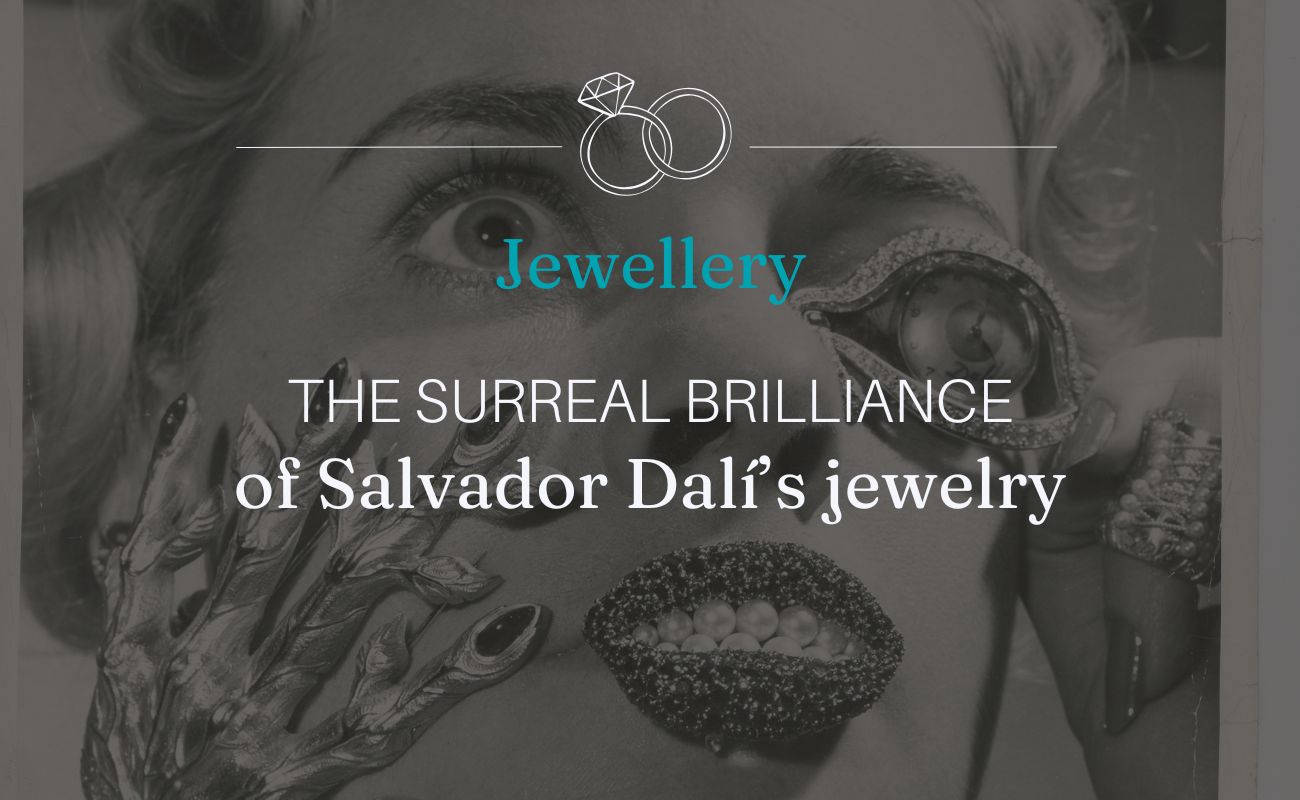
A model wears several surrealist jewelry creations designed by Salvador Dalí in the late 1940s, including the watch-brooch “The Eye of Time” positioned over her eye, the famous “Ruby Lips” adorning her mouth as a jewel, a sculptural gold hand set with precious stones, and a corset ring. These dreamlike creations — anthropomorphic hands, ruby-and-pearl lips, and an eye transformed into a timepiece — perfectly illustrate Dalí’s unique style, in which motifs from his artistic universe are transformed into precious adornments.
Dalí, jeweler of surrealism
In 1940, fleeing war-torn Europe, Salvador Dalí settled in the United States with his wife Gala. It was there that, beginning the following year, he turned to jewelry design — a new medium through which he could express his imagination in a different form. Over the next 29 years (from 1941 to 1970), Dalí created 39 high jewelry pieces: a collection of surrealist masterpieces crafted in gold and gemstones, shaped into hearts, lips, eyes, vegetal and animal forms, religious and mythological symbols, and strange anthropomorphic figures.
Like the Renaissance artists he deeply admired, Dalí refused to confine himself to painting alone and approached jewelry as an art form in its own right. Each piece was conceived as a miniature artwork in which his dreamlike universe came to life — but under the brilliance of diamonds.
To bring his jewelry to life, Dalí relied on the expertise of some of the finest jewelers of his time. He worked notably with Argentine goldsmith Carlos Alemany, based in New York, entrusting him with the task of translating his visions into tangible form. Dalí meticulously sketched each piece, specifying shapes, materials, and colors. He personally selected gemstones not only for their hues but also for their symbolic meaning, giving as much importance to conceptual depth as to aesthetic beauty.
Under his direction — and thanks to the craftsmanship of artisans such as Alemany — these unique jewels were entirely handmade to an exceptional standard. Yellow gold or platinum, diamonds, rubies, sapphires, emeralds, pearls: the richness and diversity of the materials reflect the opulence Dalí sought, while serving his exuberant imagination. Some pieces even incorporate unprecedented moving mechanisms — technical feats unheard of in jewelry at the time. Hearts appear to beat, butterfly wings flutter, and elements move to create the illusion of life.
Dalí supervised every detail and personally named each creation, often drawing inspiration from his muse Gala. Provocative by nature, he did not hesitate to design intentionally unsettling pieces — pierced or “bleeding” hearts, tiny golden hands clutching rubies, or surreal insects — inviting viewers to question their meaning. As in his paintings, time, love, death, and transformation recur as central themes. Dalí remains one of the very few visual artists of his era to have so successfully bridged fine art and decorative arts, expressing surrealism as powerfully in jewelry as on canvas.
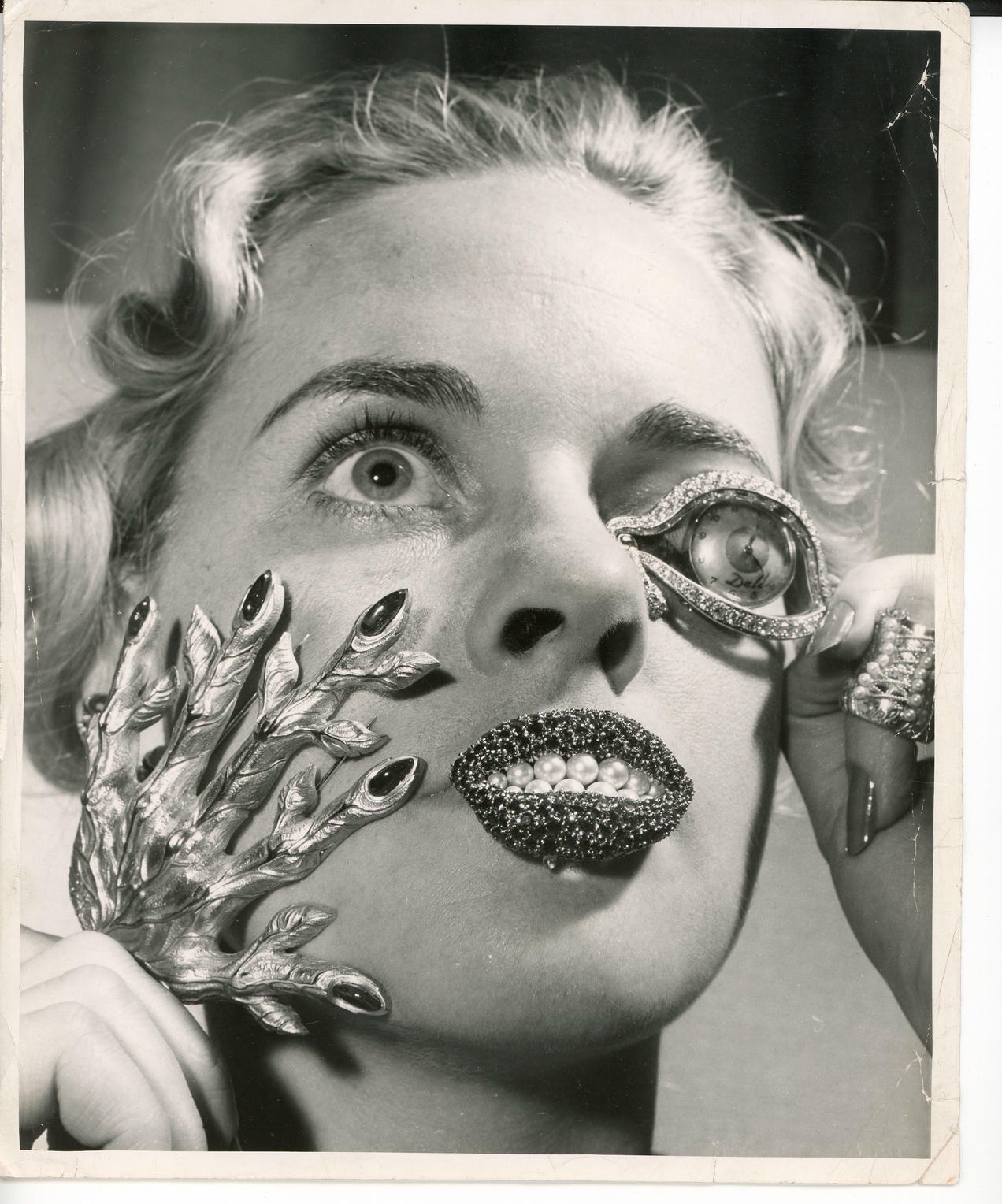
In New York, Madelle Hegeler presents jewelry pieces as intriguing as they are spectacular by Salvador Dalí: a sculpted gold hand, ruby lips adorned with pearl teeth, the “Eye of Time,” and the striking Corset Ring. (Flickr)
Dreamlike masterpieces in diamonds and gold
Among the jewels designed by Salvador Dalí, several iconic pieces stand out for both their surreal inventiveness and their extreme luxury. Here are some of the most legendary examples in the history of fine jewelry:
- The Eye of Time (1949) — A platinum watch-brooch shaped as a wide-open human eye. The eyelid is set with brilliant- and baguette-cut diamonds, a ruby marks the corner of the eye, and a diamond-set teardrop hangs below. The blue-and-violet enameled iris serves as the watch dial, complete with painted numerals and Dalí’s signature, housing a genuine Movado movement concealed within the eye. This mesmerizing piece evokes both the omniscient gaze and the passage of time — a recurring obsession in Dalí’s work.
- The Royal Heart (1953) — A manifesto of surreal opulence, this spectacular jewel is a three-dimensional heart in 18-carat yellow gold entirely covered in natural rubies, evoking flesh and blood. Crowned with a royal tiara set with rubies, sapphires, emeralds, aquamarines, peridots, garnets, amethysts, diamonds, and pearls, it embodies regal excess. Thanks to a hidden mechanical system, the heart literally beats, its rubies pulsating as if alive. One of Dalí’s most complex creations, it symbolizes both love and power and has inspired contemporary haute couture tributes.
- Ruby Lips (1949) — Inspired by the smile of actress Mae West, these sensual lips are crafted in 18-carat yellow gold set with vivid red rubies. Rows of white cultured pearls form the teeth within the slightly open mouth, creating a striking realism. Playful yet provocative, this jewel transforms the female mouth into a precious object, reflecting Dalí’s fascination with the human body and metamorphosis.
- Telephone Earrings (1950s) — A witty tribute to modern communication, these dangling earrings take the form of miniature telephone receivers. Crafted in 18-carat yellow gold and set with rubies, emeralds, and diamonds, the tiny telephones appear to whisper invisible messages. Dalí delighted in blurring the line between everyday objects and luxury, elevating the ordinary into the surreal.
The brooch “The Eye of Time” (circa 1949), crafted in platinum, diamonds, rubies, and enamel, incorporates a functioning watch dial at its center. This surreal eye shedding a diamond tear remains one of Dalí’s most iconic jewelry creations, illustrating his obsession with the passage of time.
“The Royal Heart” (1953) by Salvador Dalí — a textured solid-gold heart crowned and set with rubies and multicolored gemstones — conceals a secret mechanism that makes a smaller ruby heart beat within the reliquary. Today exhibited at the Dalí Theatre-Museum in Figueres, this masterpiece merges lavish luxury with organic symbolism.
Jewelry between art, luxury, and collection
Dalí’s surrealist jewelry deliberately blurs the boundary between art and luxury. Their value lies not only in the abundance of precious metals and gemstones, but above all in the ideas and imagination they embody. Each piece represents Dalí’s artistic genius made wearable. Whether admired as beautiful, strange, or provocative, these jewels leave no one indifferent and are now highly sought after by museums and elite collectors alike.
Beginning in the 1950s, the complete Dalí jewelry collection toured internationally, affirming its status as a body of art in its own right. The 39 pieces were initially acquired by American patrons, the Cummins Catherwood couple, before being donated to a foundation for public exhibition. After passing through several private owners — including a wealthy Saudi collector — the entire collection ultimately found its permanent home in Spain. Today, Dalí’s jewels are displayed at the Teatro-Museo Dalí in Figueres, within a dedicated space known as Dalí Joies.
From time to time, individual pieces resurface on the art market, commanding remarkable prices at auction. In October 2025, Sotheby’s sold Dalí’s surreal necklace “Swirling Sea” for €736,600 — more than double its initial estimate — following an intense bidding battle. Created in 1954 for a wealthy collector and executed by New York jewelers Alemany & Co., the necklace evokes ocean waves through fringes of pearls, emeralds, and sapphires, centered around a large baroque pearl shell. Its impressive result confirms the enduring fascination surrounding Dalí’s jewelry.
An enduring influence on high jewelry
The legacy of Salvador Dalí as a jeweler continues to inspire contemporary designers and luxury houses. In July 2025, artistic director Daniel Roseberry paid tribute to Dalí during Schiaparelli’s haute couture show in Paris. One silhouette featured a spectacular red mechanical heart necklace — a direct reference to Dalí’s Royal Heart of 1953. The homage was particularly meaningful, as Elsa Schiaparelli, founder of the house, was a close friend and collaborator of Dalí during the 1930s.
Other creators have also drawn from Dalí’s surreal imagination. Cartier’s famous “Crash” watches, with their distorted melting cases, echo the soft clocks of The Persistence of Memory (1931), illustrating how Dalí’s aesthetic continues to influence even luxury watchmaking. More broadly, the idea of jewelry as a conceptual artwork — rich in symbolism and narrative — stems directly from the path Dalí helped pioneer.
Ultimately, Salvador Dalí’s surrealist jewelry occupies a singular place in the history of fine jewelry. These extraordinary creations represent the perfect fusion of artistic vision and masterful craftsmanship. Beating hearts, watch-eyes, and ruby lips expanded the boundaries of haute joaillerie by introducing dream, humor, and provocation. Whether one embraces or resists their unconventional beauty, these jewels have become cult objects — highly collectible and eternally fascinating — offering a wearable and timeless expression of one of the greatest artists of the twentieth century.
Sources: Natural Diamonds – Only Natural Diamonds; Wilson’s Estate Jewelry; Dalí Museum (Figueres); Press archives and auction records (Sotheby’s, Schiaparelli, etc.)