Diamonds
Ancient India and the History of the First Diamonds
Ancient India: The Historic Birthplace of Diamonds
Today, when people think about diamonds, countries such as Botswana, South Africa, or Canada usually come to mind. However, for nearly two millennia, India was the world’s only known source of diamonds. Long before the discovery of modern diamond mines, the first diamonds ever found by humans came from Indian rivers and lands.
This fascinating history combines spirituality, trade, royalty, and legends. Indian diamonds were not only precious stones admired for their beauty, but also powerful symbols of strength, protection, and eternity.
The First Known Diamonds in History
Historians estimate that organized diamond mining in India dates back to around 700 BC, although some discoveries may be even older. Ancient texts and stories already mentioned these precious stones several centuries before our era.
The earliest diamonds were mainly found in the alluvial deposits of the Krishna, Godavari, and Penner rivers. These regions now correspond to the Indian states of Andhra Pradesh and Telangana. Local inhabitants likely collected diamonds directly from riverbeds, especially after seasonal floods.
At that time, diamonds were a true mystery for ancient civilizations. No other known material possessed such incredible hardness. People could neither easily break them nor properly cut them using the tools available at the time.
The word “diamond” comes from the Greek word adamas, meaning “invincible” or “indestructible.” This origin perfectly illustrates the fascination inspired by this extraordinary stone.
A Sacred Stone in Ancient Indian Civilizations
In ancient India, diamonds were not considered merely luxury objects. They also held strong spiritual and religious significance.
Hindu, Buddhist, and Jain texts have mentioned diamonds for more than 2,000 years. Some ancient writings attributed protective and mystical powers to them. Diamonds were believed to bring strength, prosperity, and protection to those who wore them.
In certain Sanskrit treatises, diamonds were described according to their brilliance, color, and purity. A bright, transparent, flawless stone was considered especially auspicious. On the other hand, stained or cracked diamonds could be associated with bad omens.
Diamonds were therefore reserved for kings, warriors, priests, and noble families. They symbolized authority, divine power, and eternity.
The Legendary Golconda Mines
The history of Indian diamonds is inseparable from the famous Golconda mines.
Contrary to popular belief, Golconda did not refer to a single mine, but rather to a vast region and an important diamond trading center located in southern India, near present-day Hyderabad.
For centuries, diamonds extracted from the various mines in the region were transported to Golconda, where they were sorted, cut, polished, and sold to foreign merchants.
From the Middle Ages onward, the name “Golconda” gradually became synonymous with immense wealth and diamonds of exceptional quality. Stones from this region were especially renowned for their remarkable purity, transparency, and brilliance.
Even today, “Golconda diamonds” remain among the rarest and most prestigious gemstones in the world of high jewelry.
Legendary Diamonds from India
Indian mines produced some of the most famous diamonds in history. These gems crossed centuries, empires, and continents, becoming true legends.
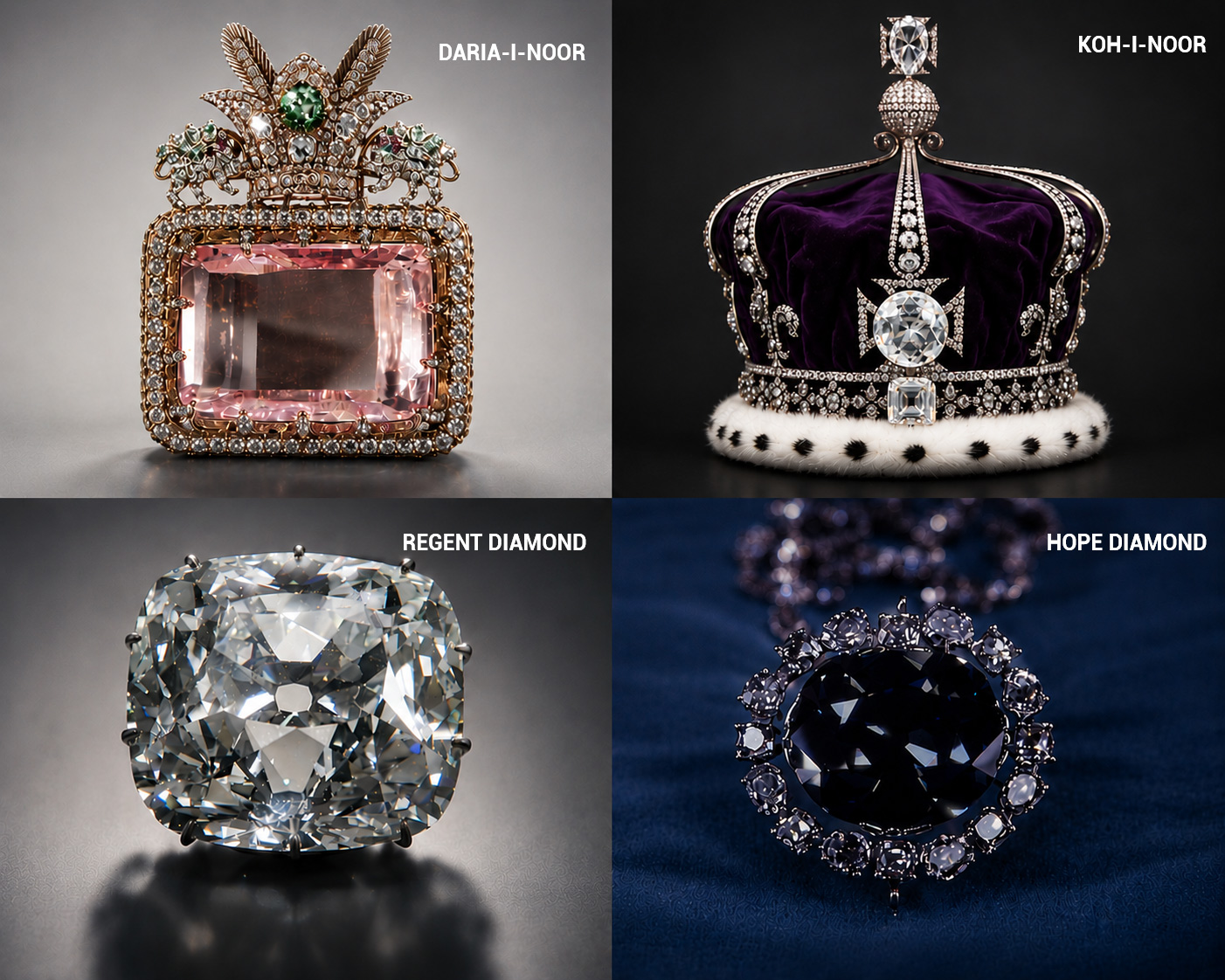
The Daria-i-Noor
The Daria-i-Noor, whose name means “Sea of Light,” is a massive pink diamond of Indian origin. Today, it is part of the Iranian National Jewels.
The Koh-i-Noor
The Koh-i-Noor is probably the most famous Indian diamond in the world. Its name means “Mountain of Light.” After belonging to Mughal emperors and Persian and Afghan rulers, it was eventually taken by the British in the 19th century.
Today, it is part of the British Crown Jewels. Its history remains surrounded by political debates, symbolism, and numerous legends.
The Regent Diamond
The Regent Diamond was discovered in India at the end of the 17th century. This exceptional diamond adorned the jewels of the French monarchy before eventually being preserved at the Louvre Museum.
It is often considered one of the most beautiful historic white diamonds ever discovered.
The Hope Diamond
The Hope Diamond is a famous blue diamond believed to have been extracted from the Indian mines of the Golconda region. Its intense color and mysterious history made it one of the world’s most iconic diamonds.
It is currently displayed at the Smithsonian Museum in Washington.
Its size, color, and remarkable history make it an exceptionally rare gemstone.
India at the Center of the Global Diamond Trade
For nearly 2,000 years, India completely dominated the global diamond trade. Diamonds extracted in southern India were transported to Persia, the Roman Empire, the Middle East, and later medieval Europe.
Indian merchants played a crucial role in spreading diamonds across the world. Trade routes allowed these precious stones to travel vast distances, often accompanied by fantastic stories and mysterious beliefs.
Travelers and writers of Antiquity already spoke of these stones coming from India. Some legends described valleys filled with diamonds protected by serpents or mythical creatures. These tales further reinforced the diamond’s image as a rare and almost unreachable treasure.
The End of India’s Monopoly
For a very long time, India remained the only known source of diamonds in the world. This monopoly came to an end in the 18th century with the discovery of new deposits in Brazil, followed by South Africa in the 19th century.
These discoveries completely transformed the global diamond market. Available volumes increased, trade routes evolved, and the influence of Indian mines gradually declined.
However, India still holds a major place in today’s diamond industry, particularly thanks to its historic expertise in cutting, polishing, and trading precious stones.
A Legacy Still Alive in Modern Jewelry
Even thousands of years after the first discoveries, Indian diamonds continue to fascinate collectors, historians, and luxury jewelry houses.
The term “Golconda” remains associated with exceptional diamonds, highly sought after for their purity, rarity, and historical prestige.
Beyond their financial value, these gemstones tell the story of the first civilizations fascinated by a unique mineral. Formed deep within the Earth billions of years ago, diamonds gradually became one of the universal symbols of power, luxury, and eternity.
Ancient India therefore occupies a foundational place in the history of diamonds. Without its rivers, mines, and merchants, the worldwide fascination for this precious stone would probably never have reached such heights.