Diamonds
Can you really buy a diamond online safely?
Yes, it is possible to buy a diamond online without taking unnecessary risks, provided you know what to check. The issue is not the sales channel itself, but the seller’s reliability, the clarity of the documentation, and the transparency surrounding each stone. A reputable website can offer just as much security as a physical store, and sometimes even more, thanks to the amount of information available.
However, caution is still essential, as a diamond should rarely be chosen on impulse. Its price depends on several technical criteria, the reliability of its certificate, and the actual quality of its cut. To buy a diamond with confidence, you need to compare your options, verify the details, and avoid promises that seem too good to be true.
The following sections provide the essential guidelines for assessing a seller, understanding a stone’s value, and securing every stage of the purchase, from payment to delivery. You will also learn how to read a certificate, identify excellent brilliance, and choose between a natural and a lab-grown diamond.
Before going into detail, I invite you to watch my interview about buying diamonds online. In it, we take a practical look at the precautions you should take, the guarantees you should require, and the pitfalls you should avoid when purchasing a stone online.
Can You Really Buy a Diamond Online? How to Avoid Unpleasant Surprises
The answer is yes, but only if the website provides complete and verifiable information. A trustworthy seller clearly displays the stone’s origin and characteristics, the return policy, and full contact details. The greater the transparency, the more justified your confidence will be.
The main advantage of buying online is the ability to compare options quickly. In just a few minutes, you can compare several stones by price, carat weight, color, and clarity. This broader perspective can often help you make a better choice than in a physical store, where emotion may lead you to decide too quickly.
Trust Signals to Check Before Choosing a Seller
A reputable seller does more than display an attractive photograph. The website should provide a physical address, complete legal information, accessible customer service, and consistent customer reviews. The seller’s reputation matters just as much as the quality of the diamonds on offer.
- Clear and responsive customer service
- Complete and verifiable contact details
- Detailed, recent, and credible reviews
- A clear return policy
- Technical documentation available before purchase
Be wary of marketplaces where the seller is difficult to identify. To buy a diamond with peace of mind, it is best to choose a specialist retailer that inspects its stones and accepts full commercial responsibility. Traceability is a mark of quality, not merely an administrative detail.
Photos, Videos, and Remote Inspection: What You Should Expect
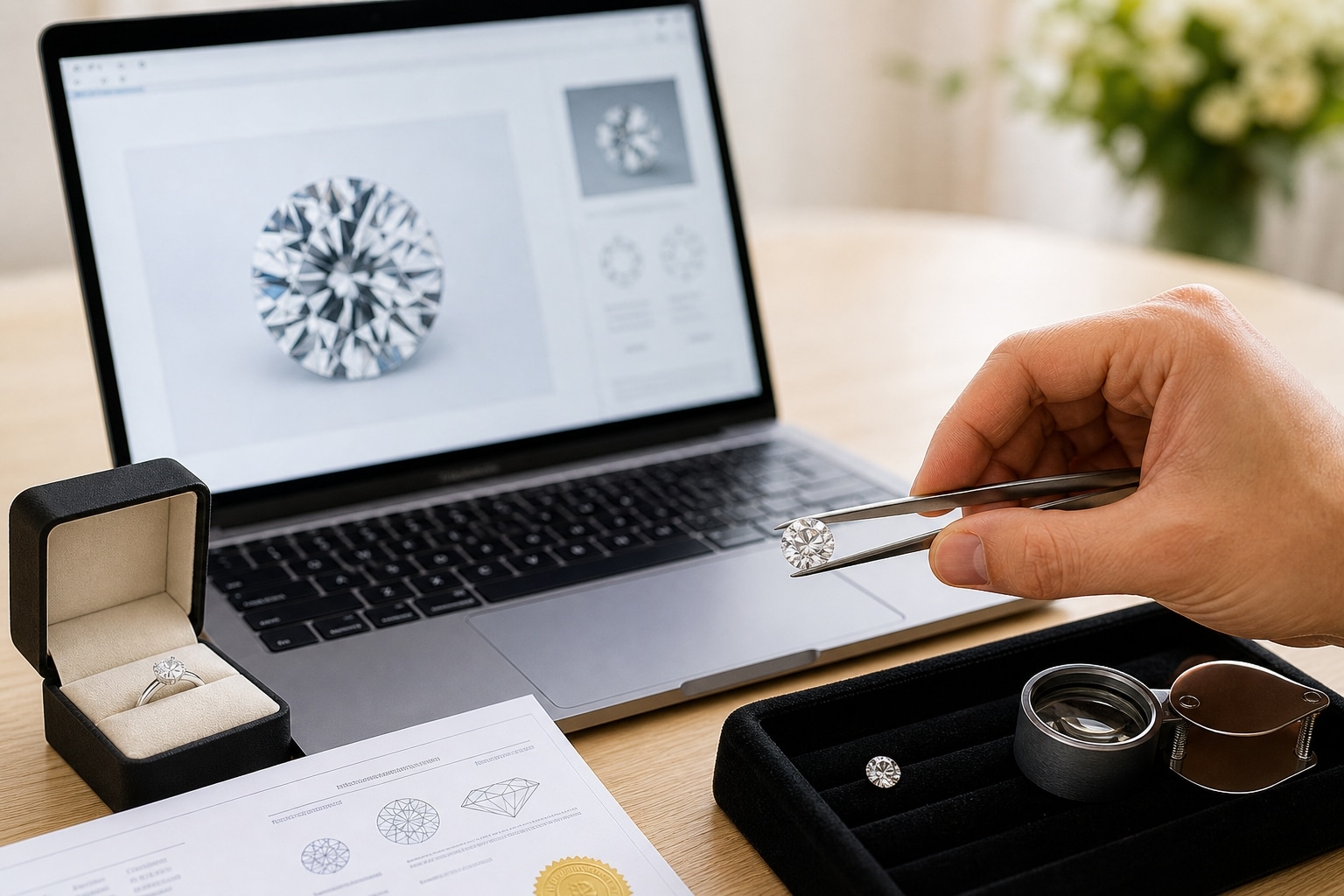
Flattering images are never enough. Ask for high-definition photographs, a 360-degree video, and, if possible, views under different lighting conditions. These materials make it easier to assess the cut, symmetry, and any inclusions.
A good website may also offer a remote inspection with an expert or specialist adviser. This step can help you avoid choosing a stone that looks beautiful in a photograph but appears less balanced in person. It also helps you compare several options without relying solely on marketing images.
Why a Certificate Is Essential When Buying a Diamond
A gemological certificate is the foundation of any informed decision. It describes the stone according to standardized criteria and allows you to determine whether its characteristics are consistent with the asking price. Without a reliable certificate, the stated value is difficult to substantiate.
The best-known laboratories include GIA, HRD, and IGI. Their role is essential because they provide an independent framework of trust separate from the seller. For a buyer, this is the best way to know exactly what is being offered.
What a Reliable Certificate Should Include
A complete certificate should state the diamond’s carat weight, color, clarity, cut, dimensions, and sometimes its fluorescence. It should also specify the proportions and the report number associated with the stone. This information allows you to compare several offers objectively.
- A unique report number
- Exact carat weight
- Color and clarity grades
- Cut and polish grades
- Symmetry and dimensions
Always check that the report number matches the diamond delivered to you. A certificate is valuable only if it is authentic and linked to the correct stone. If the seller refuses to provide this proof, it is best not to place the order.
GIA, HRD, and IGI: Why These Laboratories Matter
GIA is widely regarded as an industry benchmark because of the rigor of its assessments. HRD and IGI are also recognized and commonly used in the international diamond trade. A report from one of these laboratories provides reassurance by reducing the risk of artificial overvaluation.
When buying a diamond online, this point is crucial. A certificate issued by a credible laboratory helps you compare values, understand the stone’s true quality, and make a more rational investment. It may also help you justify the price if you decide to resell the diamond in the future.
Understanding the 4Cs Before Buying a Diamond Online
A diamond’s value is based on the 4Cs: carat, color, clarity, and cut. These criteria should always be considered together, as focusing on just one can distort your assessment. A beautiful stone should not be judged solely by its weight or apparent size.
Carat weight affects the price, but not necessarily the diamond’s perceived beauty. A stone with a good color grade and an excellent cut can display more brilliance than a heavier but poorly cut diamond. This is why each criterion must be balanced carefully.
Carat, Color, and Clarity: How to Assess Overall Value
Carat measures weight, not brilliance. Two diamonds of the same weight can have different values depending on their color and clarity. Small inclusions that are invisible to the naked eye do not have the same impact as a visible flaw.
Color affects how white a diamond appears and, therefore, its value. A stone with a high color grade may look brighter, especially when it also has an excellent cut. The right choice depends on your budget and intended use, particularly if the diamond is for a ring or engagement jewelry.
- Carat weight has a major impact on price
- Color affects the perceived whiteness of the stone
- Clarity measures inclusions and blemishes
- Cut determines visible brilliance
Why a Diamond’s Cut Has Such a Strong Impact on Its Brilliance
Cut is often the factor that makes the greatest difference to a diamond’s actual brilliance. A well-proportioned stone reflects light more effectively and appears more vibrant. Excellent and Very Good cut grades are generally the best options to look for.
You should also consider polish and symmetry, as both affect the final appearance. A poor cut can significantly reduce a diamond’s visual impact, even if it has a high carat weight. To buy wisely, prioritize the overall balance of the stone rather than focusing on a single number.
How to Identify a Trustworthy Diamond Seller and Secure Your Payment
A trustworthy seller inspires confidence through transparency and high-quality support. They do not hide a stone’s limitations and provide precise explanations of each characteristic. This approach is often more reassuring than purely promotional language.
Payment and delivery should also protect the buyer. A card with 3D Secure, a recognized payment service, or a virtual card can reduce risk. The parcel should be sealed, fully insured, and delivered with signature confirmation.
Best Practices for Safe Payment and Delivery
Choose payment methods that offer genuine buyer protection. Avoid direct bank transfers to a little-known seller when no safeguards protect the transaction. A reputable website offers secure options and clearly explains the payment process.
- Secure payment with enhanced authentication
- Fully insured and tracked delivery
- Signature required upon delivery
- Discreet, sealed packaging
Secure shipping is just as important as the quality of the stone. A good service should allow you to receive your jewelry without stress or uncertainty. This is a strong indicator of professionalism.
Returns, Warranties, and Suspicious Prices: Warning Signs to Watch For
A clear return policy is essential, especially for a distance purchase. It shows that the seller is willing to let you assess the diamond after delivery and has nothing to hide. The warranty covering defects should also be clear and easy to access.
Be cautious of unusually low prices. A significant price difference may indicate inferior quality, an unreliable certificate, or a misleading sales strategy. To avoid a deal that is too good to be true, compare several offers and always ask the seller to explain the price.
The best price is not necessarily the lowest. It is the price that most accurately reflects the diamond’s actual quality, market value, and intended use. This principle is even more important when choosing between a natural and a lab-grown diamond.
Natural or Lab-Grown Diamond: Which Should You Choose for Your Budget and Plans?
Natural diamonds remain associated with rarity and long-term heritage value. Lab-grown diamonds, by contrast, often allow you to obtain a larger-looking stone or a higher carat weight for the same budget. Both options have their place, depending on your priorities.
Your choice will also depend on ethical considerations and how you perceive value. Some buyers want a natural gemstone for its history, while others prefer a lab-grown diamond to optimize value for money. Both approaches can be perfectly valid.
- Natural diamond: rarity, tradition, and a strong perception of value
- Lab-grown diamond: controlled budget, ethical considerations, and often a higher carat weight
- In both cases: certification, transparency, and comparison remain essential
For a symbolic piece of jewelry such as an engagement ring, the decision often depends on its emotional significance and your budget. For an investment, rarity and traceability become more important. In every case, you should be able to explain and justify the quality you have chosen.
How to Compare Diamonds and Find the Best Value for Money
The most common mistake is to focus on a single criterion, usually carat weight. A smarter approach is to balance color, clarity, and cut to achieve better overall value. The goal is not to pay more, but to pay the right price.
Comparing several stones on the same website or across different websites will help you understand price differences. You will quickly see which offers are reasonable and which appear overpriced. This method can prevent considerable regret after your purchase.
Taking your time remains the best form of protection. A good seller will not pressure you into making an urgent decision and will provide enough information for a meaningful comparison. When everything is clear, the purchase becomes simpler, safer, and more satisfying.
In practice, buying a diamond online can be an excellent option if you maintain a careful verification process. Check the certificate, the seller’s reputation, the quality of the cut, the security of the payment method, and the return conditions. With these guidelines, you can make a sound decision and better justify the value of the diamond you choose.