Diamonds
Dresden Green Diamond: History of the 41-Carat Green Diamond
Among famous diamonds, some are known for their size, others for their history or their owners. The Dresden Green Diamond brings together almost all of these qualities at once. Weighing around 41 carats, displaying a natural green color and boasting nearly three centuries of documented history, it is considered one of the most extraordinary green diamonds in the world.
But its true uniqueness lies in more than its size. The Dresden Green is also a fascinating case for gemologists: its color formed naturally during its long journey deep within the Earth, through a process very different from the one responsible for the color of many other fancy-colored diamonds.
A natural green diamond of around 41 carats
The Dresden Green Diamond weighs approximately 41 carats. It features an antique pear-shaped cut and a remarkably even green color, an extremely rare characteristic for a natural diamond of this size.
Its origin is generally associated with India and the historic diamond-producing regions of Golconda, which yielded some of the most famous gemstones in history. The diamond had already been cut by the time it appeared in European collections in the 18th century.
Why do some diamonds turn green?
A diamond’s color can have very different origins. In some blue diamonds, for example, the presence of boron plays a decisive role. Yellow diamonds generally owe their color to the presence of nitrogen.
For natural green diamonds, the mechanism is different. The color can develop when a diamond is exposed over a very long period of time to a natural source of radiation present in the surrounding rocks.
This irradiation alters certain defects within the diamond’s crystal structure. The crystal then absorbs specific wavelengths of light, which can produce a green appearance.
In most natural green diamonds, this coloration remains mainly concentrated near the surface. Finding a diamond with a strong and sufficiently even green color that remains visible after cutting is therefore particularly exceptional.
A type IIa diamond
The Dresden Green belongs to the category of type IIa diamonds. This gemological classification refers to diamonds containing very little measurable nitrogen in their crystal structure.
Type IIa diamonds represent only a small fraction of natural diamonds and include several famous historic stones. They are particularly prized for their high chemical purity.
A study conducted by the Gemological Institute of America in the late 1980s confirmed the exceptional nature of the Dresden Green Diamond. The stone was notably described as a type IIa diamond displaying a green color of natural origin.
A gemstone studied to better understand green diamonds
The Dresden Green is also of major scientific interest. One of the challenges of modern gemology is to distinguish a green diamond that has been naturally irradiated within the Earth from a diamond whose color has been artificially produced or modified.
Certain treatment techniques can reproduce phenomena similar to those observed in nature. Gemological laboratories therefore need to analyze several characteristics, including absorption spectra, color distribution, inclusions, fluorescence and defects within the crystal lattice.
In this respect, the Dresden Green serves as a kind of historic reference, since its color predates modern techniques used to artificially irradiate diamonds by several centuries.
A history dating back to the 18th century
The earliest known European references to the diamond date back to the beginning of the 18th century. The stone later appeared in Saxony and entered the royal collections of Dresden.
During the 18th century, the Saxon rulers assembled one of Europe’s most spectacular treasure collections at Dresden Castle: the Green Vault, or Grünes Gewölbe.
The green diamond became one of the most iconic pieces in this collection. It was incorporated into a spectacular jewel, surrounded by numerous colorless diamonds designed to visually enhance the intensity of its green color.
Wars, evacuations and return to Dresden
Over the course of nearly three centuries of European history, the diamond survived several particularly turbulent periods.
It was placed in safekeeping during various conflicts and later evacuated before the bombing of Dresden during the Second World War. After the war, part of the collection was transferred to the Soviet Union before eventually being returned to Dresden in the 1950s.
The diamond therefore survived several wars, major political transformations in Europe and the destruction of much of Dresden’s historic city center.
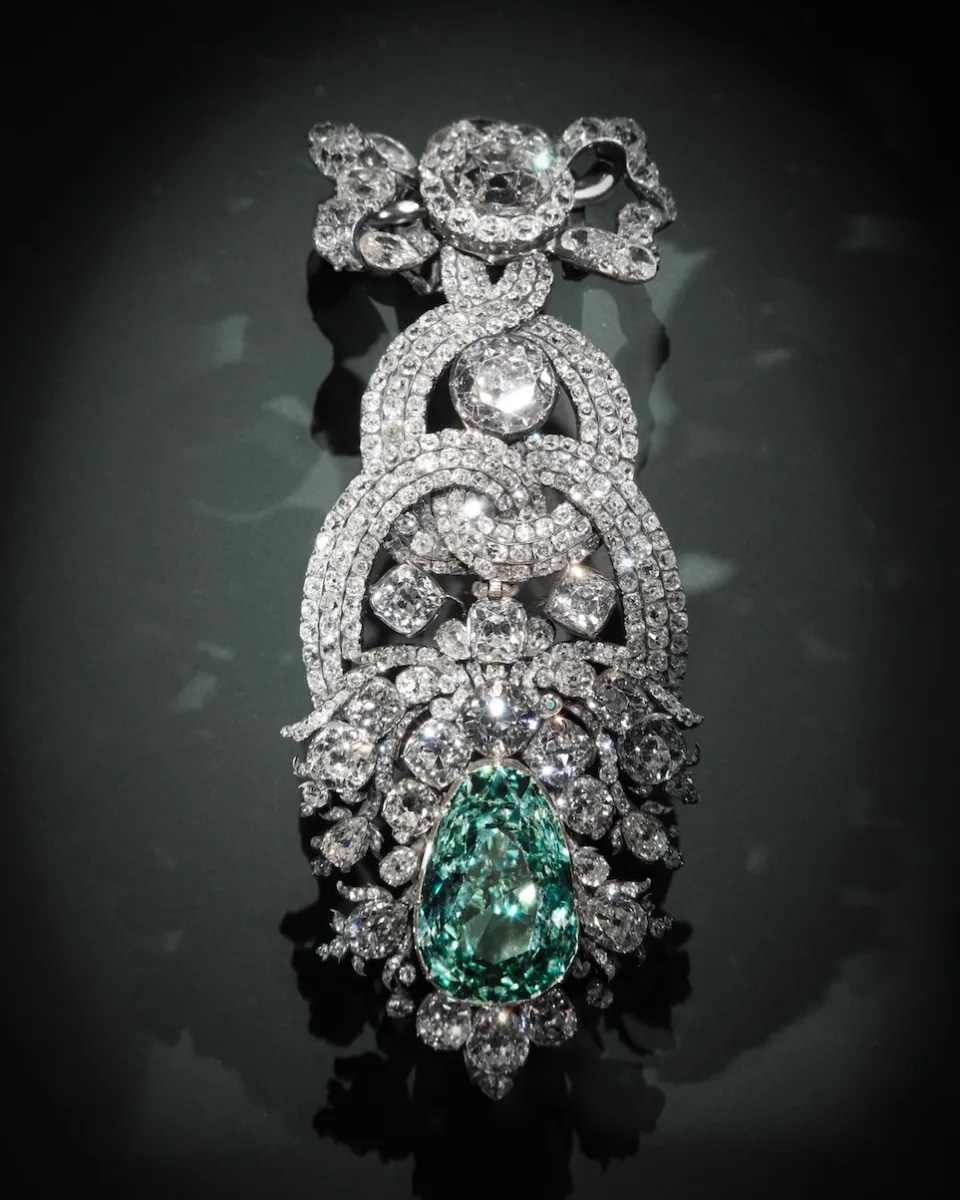
(Photograph by Benjamin Bouchet for Only Natural Diamonds)
The 2019 Green Vault robbery
The Green Vault returned to international headlines in November 2019, when a spectacular robbery targeted the historic collections of Dresden Castle.
Several 18th-century jewels set with diamonds were stolen. The Dresden Green, however, was not among them. At the time of the robbery, it was in the United States as part of an exhibition at the Metropolitan Museum of Art in New York.
It is worth noting that the green diamond is usually displayed in the New Green Vault, while the robbery targeted the rooms of the Historic Green Vault located on a different floor of the castle.
Can a value be placed on the Dresden Green Diamond?
It is tempting to assign a spectacular financial value to such a famous diamond. In the case of the Dresden Green, however, a conventional market valuation has little meaning.
Its value does not depend solely on its weight, color or clarity. It also lies in its age, provenance, scientific importance and role in the history of European royal collections.
A diamond of this kind belongs more to the category of cultural heritage objects than to that of gemstones likely to be offered for sale on the market.
Why is the Dresden Green unique?
The Dresden Green Diamond combines an almost impossible set of qualities: an exceptional size for a natural green diamond, remarkable color, high chemical purity and a documented history spanning nearly three centuries.
Above all, it illustrates an essential principle of gemology: in a natural colored diamond, rarity does not depend solely on the intensity of the color. It also depends on the geological phenomenon that created it and on the extremely low probability that this color will survive crystal growth, erosion, extraction and finally the cutting process.
The Dresden Green is therefore much more than a famous green diamond. It is one of the most striking examples of how a diamond’s geological history can, billions of years later, become part of human history.