Diamonds
Tiffany Diamond: History of the Famous 128-Carat Yellow Diamond
Some diamonds become famous because of their size, others because of their owners or a spectacular sale. The Tiffany Diamond belongs to an even rarer category: gemstones that have become true cultural icons.
With its 128.54 carats, intense yellow color and a history spanning nearly a century and a half, this exceptional diamond is now inseparable from Tiffany & Co. Audrey Hepburn, Lady Gaga and Beyoncé have all contributed to its legendary status, but behind its glamorous image lies, above all, a truly remarkable gemstone from a gemological perspective.
A 287.42-carat rough diamond discovered in South Africa
The story of the Tiffany Diamond begins in 1877 in South Africa, at a time when diamond discoveries in the Kimberley region were profoundly transforming the global diamond market.
An exceptional 287.42-carat rough diamond was discovered there. Its impressive size, and above all its remarkable yellow color, quickly attracted attention.
The following year, in 1878, the diamond was acquired by Charles Lewis Tiffany, founder of Tiffany & Co. The acquisition helped establish the international reputation of the New York jewelry house and of its founder, who soon became associated with some of the finest gemstones of his era.
From 287 to 128.54 carats: choosing beauty over weight
One of the most fascinating aspects of the Tiffany Diamond's history is the transformation of the original rough stone.
From a 287.42-carat crystal, the cutters chose to create a diamond weighing 128.54 carats. A considerable proportion of the original weight was therefore sacrificed during the cutting process.
This decision illustrates an essential principle when working with exceptional diamonds: retaining the maximum possible weight is not always the primary objective. The cut must above all optimize light performance, color and the overall balance of the stone.
The Tiffany Diamond was given an elaborate brilliant cushion cut featuring 82 facets, more than the 58 facets traditionally associated with the modern round brilliant cut.
This architecture helps light travel through the diamond and enhances its exceptional yellow color.
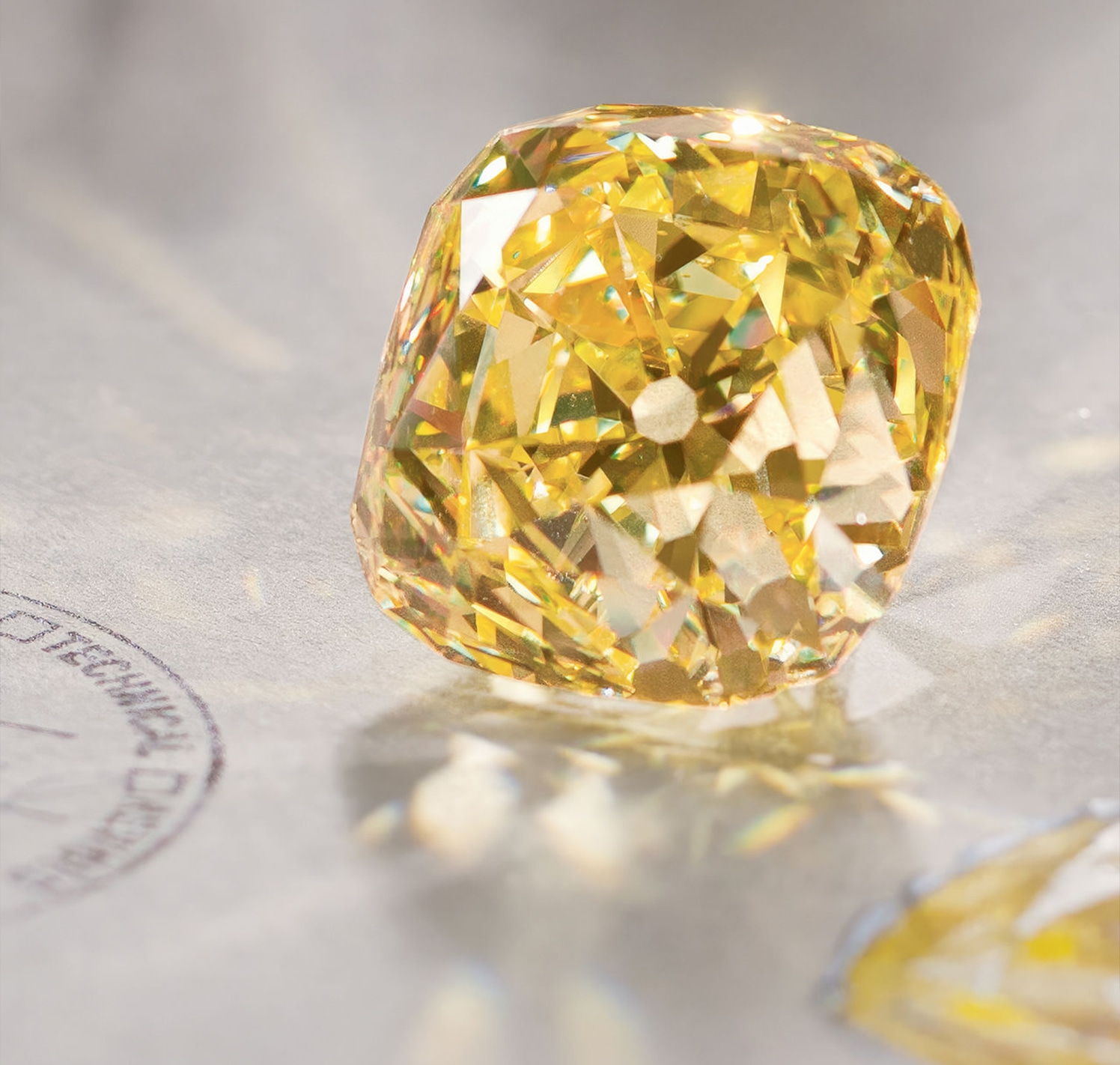
Photo credit: Tiffany & Co.
Why is the Tiffany Diamond yellow?
Most diamonds intended for jewelry are graded according to a color scale traditionally ranging from D, for the most colorless stones, to Z, as the presence of yellow becomes increasingly noticeable.
Beyond a certain level of saturation, however, the principle changes: color is no longer regarded as a drawback. Instead, it becomes one of the gemstone's defining characteristics.
This is the world of colored diamonds, also known as Fancy Color Diamonds.
In natural yellow diamonds, this color is mainly linked to the presence of nitrogen within the crystal structure. Certain nitrogen atoms absorb part of the visible light spectrum, giving the diamond a yellow appearance of varying intensity.
The stronger and more remarkable the saturation, the rarer and more sought-after the diamond can become.
The Tiffany Diamond, an ambassador for yellow diamonds
Through the Tiffany Diamond, Tiffany & Co. helped make the yellow diamond particularly recognizable to the general public.
Unlike many important historic diamonds that changed ownership several times, the Tiffany Diamond has remained associated with the jewelry house that acquired it in the 19th century.
It gradually became far more than an exceptional gemstone: it came to symbolize Tiffany's gemological expertise and jewelry craftsmanship.
The diamond has been displayed at various events and, over the years, has appeared in several high jewelry creations.
Audrey Hepburn and Breakfast at Tiffany's
One of the most famous images associated with the Tiffany Diamond is, of course, that of Audrey Hepburn.
In 1961, the actress starred in Breakfast at Tiffany's. The film permanently helped associate New York elegance with the world of Tiffany & Co.
For the promotion of the film, Audrey Hepburn posed with the famous yellow diamond mounted on the spectacular Ribbon Rosette necklace designed by Jean Schlumberger.
One important detail should nevertheless be clarified: contrary to a commonly repeated misconception, Audrey Hepburn did not actually wear the Tiffany Diamond around her neck in the film itself. The famous photographs featuring the diamond were primarily created as part of the film's promotional campaign.
Nevertheless, the combination of Audrey Hepburn, her black dress and the spectacular yellow diamond became one of the most iconic images in Tiffany's history.
Jean Schlumberger and the famous Bird on a Rock
The history of the Tiffany Diamond is also closely linked to designer Jean Schlumberger, one of Tiffany & Co.'s great designers of the 20th century.
Schlumberger was renowned for jewelry inspired by the animal and plant worlds, in which precious stones seemed to become living elements.
In 1995, the Tiffany Diamond was notably presented in an interpretation of the famous Bird on a Rock motif during a retrospective dedicated to the designer at the Musée des Arts Décoratifs in Paris.
The contrast was striking: one of the world's most famous yellow diamonds became the perch upon which a tiny jeweled bird appeared to rest.
Lady Gaga wears the Tiffany Diamond at the Oscars
After spending several decades primarily within Tiffany's collections and exhibitions, the diamond returned to the spotlight in 2019.
That year, Lady Gaga wore the Tiffany Diamond to the Academy Awards.
The appearance attracted considerable attention. The singer and actress had just achieved enormous success with the film A Star Is Born and that evening won the Academy Award for Best Original Song for Shallow.
The diamond was placed at the center of a spectacular necklace set with numerous white diamonds, creating a contrast designed to emphasize its distinctive yellow color even further.
This appearance introduced the Tiffany Diamond to a new generation, almost sixty years after Audrey Hepburn's famous photographs.
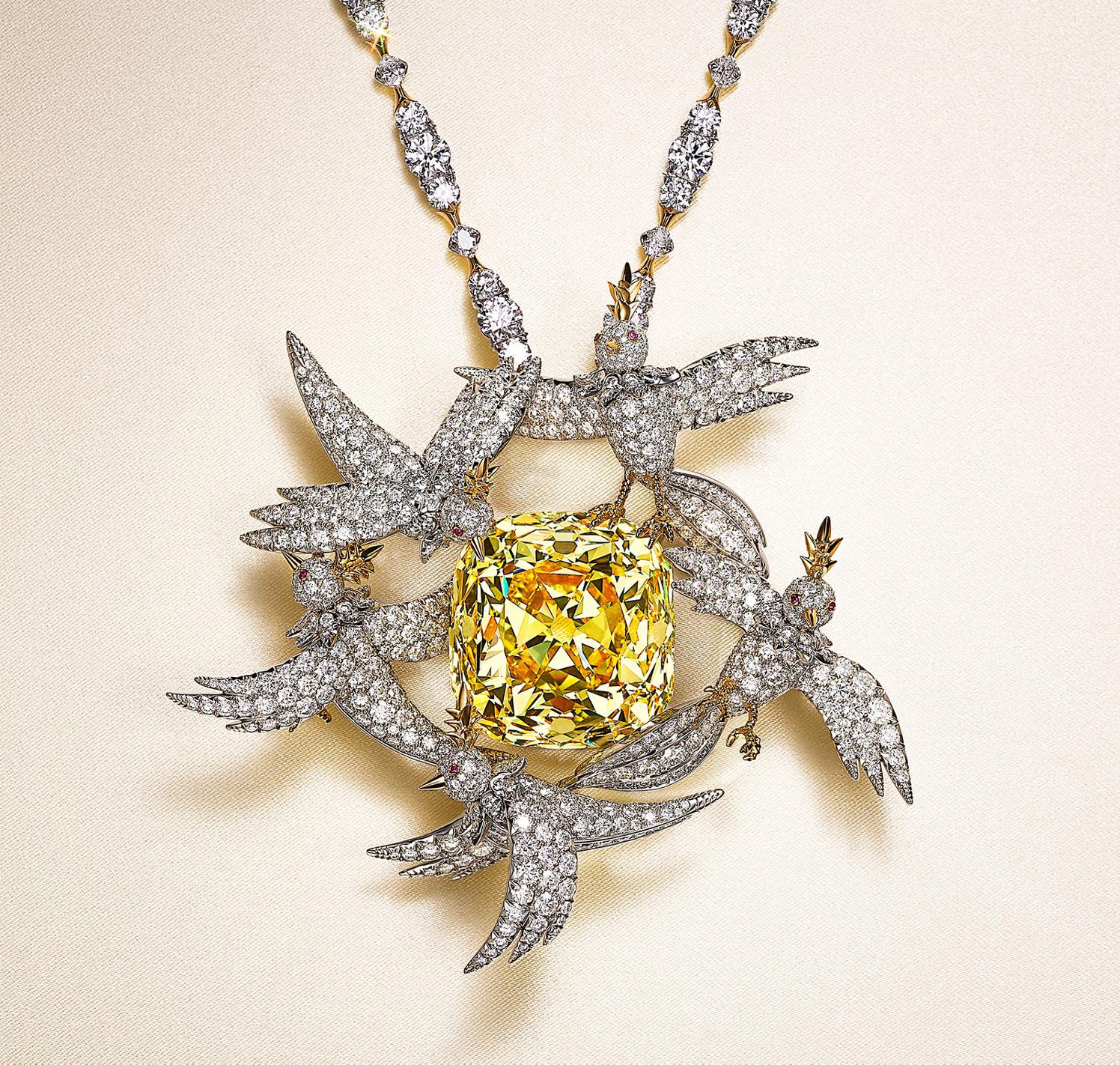
Photo credit: Tiffany & Co.
Beyoncé and the Tiffany Diamond
Two years later, in 2021, another international icon was chosen to wear the stone: Beyoncé.
She appeared wearing the Tiffany Diamond alongside Jay-Z in Tiffany & Co.'s About Love campaign.
The photographs deliberately echoed Audrey Hepburn's visual universe: a black dress, elegant hairstyle and spectacular yellow diamond became a contemporary reinterpretation of Tiffany's classic image.
Beyoncé thus joined the extremely exclusive circle of women who have publicly worn the famous gemstone.
Only a few women have worn the Tiffany Diamond
Despite nearly 150 years in Tiffany's collections, the diamond has rarely been worn.
Before Beyoncé, it had notably been worn by Mary Whitehouse in 1957, Audrey Hepburn for the 1961 promotional photographs and Lady Gaga at the 2019 Academy Awards.
The rarity of these appearances naturally contributes to the diamond's legendary status. Unlike a gemstone that is regularly offered for sale or worn by different owners, every public appearance of the Tiffany Diamond becomes an event in its own right.
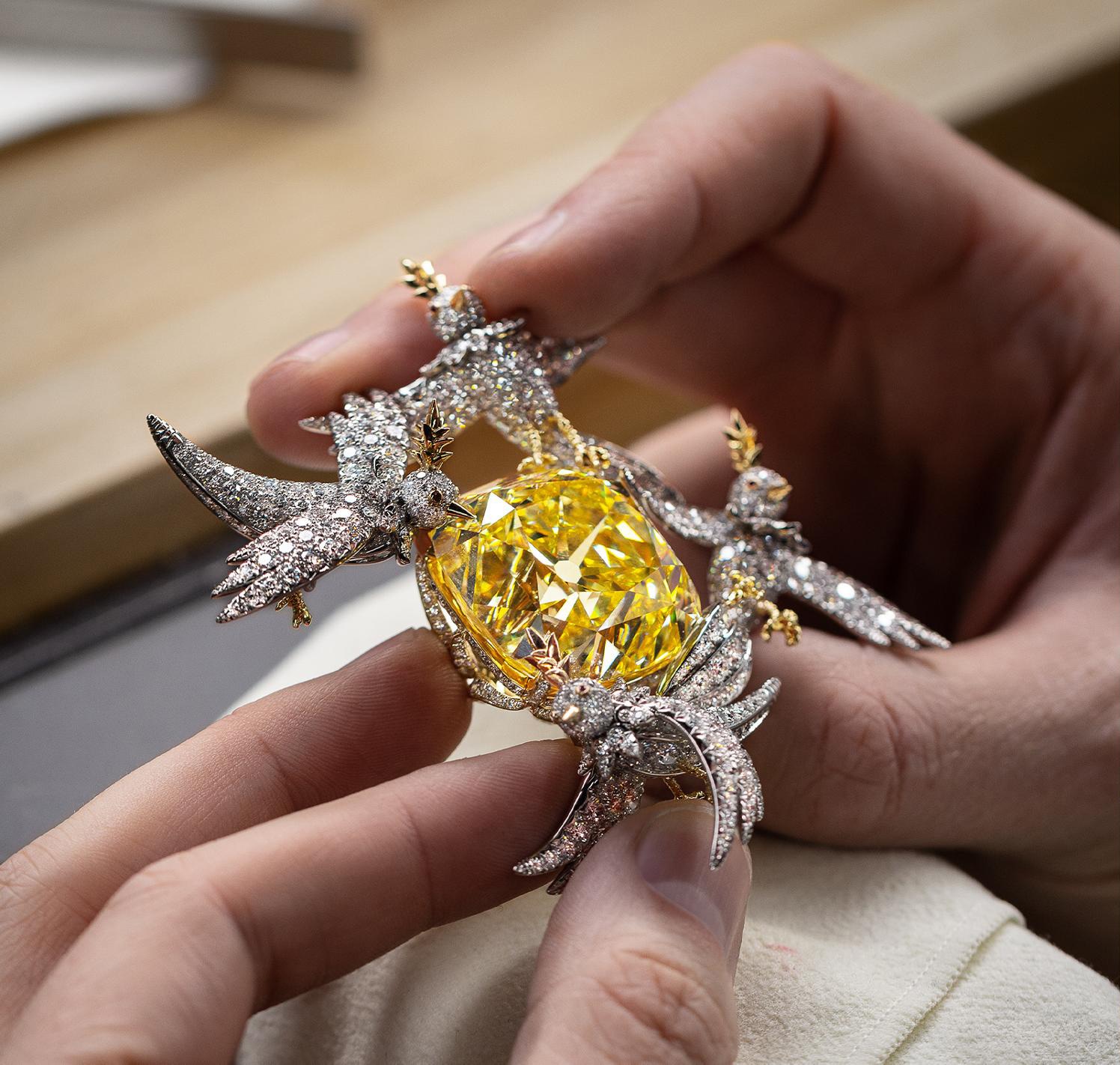
Photo credit: Tiffany & Co.
How much is the Tiffany Diamond worth?
The question of the Tiffany Diamond's value comes up regularly. Yet assigning an exact price to such a gemstone is particularly difficult.
The diamond is not exceptional solely because of its weight of 128.54 carats. Its color, cut, age, provenance and, above all, its history with Tiffany & Co. give it a heritage value that cannot be directly compared with that of a diamond available on the open market.
The world's most famous colored diamonds often share this characteristic: their theoretical value extends far beyond a conventional gemological assessment based on carat weight, color, clarity and cut.
Since the Tiffany Diamond is not intended to be sold, any financial valuation remains largely hypothetical.
Why are large yellow diamonds so rare?
Yellow diamonds are not, in absolute terms, the rarest colored diamonds. They are notably more common than red, blue or certain pink diamonds.
The situation changes considerably, however, when looking for a combination of strong color saturation, significant size, good transparency and exceptional crystal quality.
As carat weight increases, it becomes increasingly difficult to find all of these characteristics combined in a single stone.
This is precisely what makes a natural yellow diamond weighing more than 100 carats so spectacular.
A diamond that became an icon
Today, the Tiffany Diamond is far more than a 128.54-carat yellow diamond.
Its discovery in South Africa, its acquisition by Charles Lewis Tiffany, its spectacular 82-facet cut and its appearances around the necks of some of the most famous women of their time have gradually transformed the gemstone into a true cultural icon.
From Audrey Hepburn to Lady Gaga and then Beyoncé, each appearance has added a new chapter to its history without changing what makes the diamond truly unique: an extraordinary natural gemstone whose color formed deep within the Earth long before Tiffany & Co. turned it into one of the most recognizable diamonds in the world.
The Tiffany Diamond perfectly illustrates the difference between a large diamond and a historic diamond: the rarity of the stone creates its value, but it is the stories accumulated around it that build its legend.