Jewellery
Opal: Colours, Meaning and the Secrets of a Fascinating Gemstone
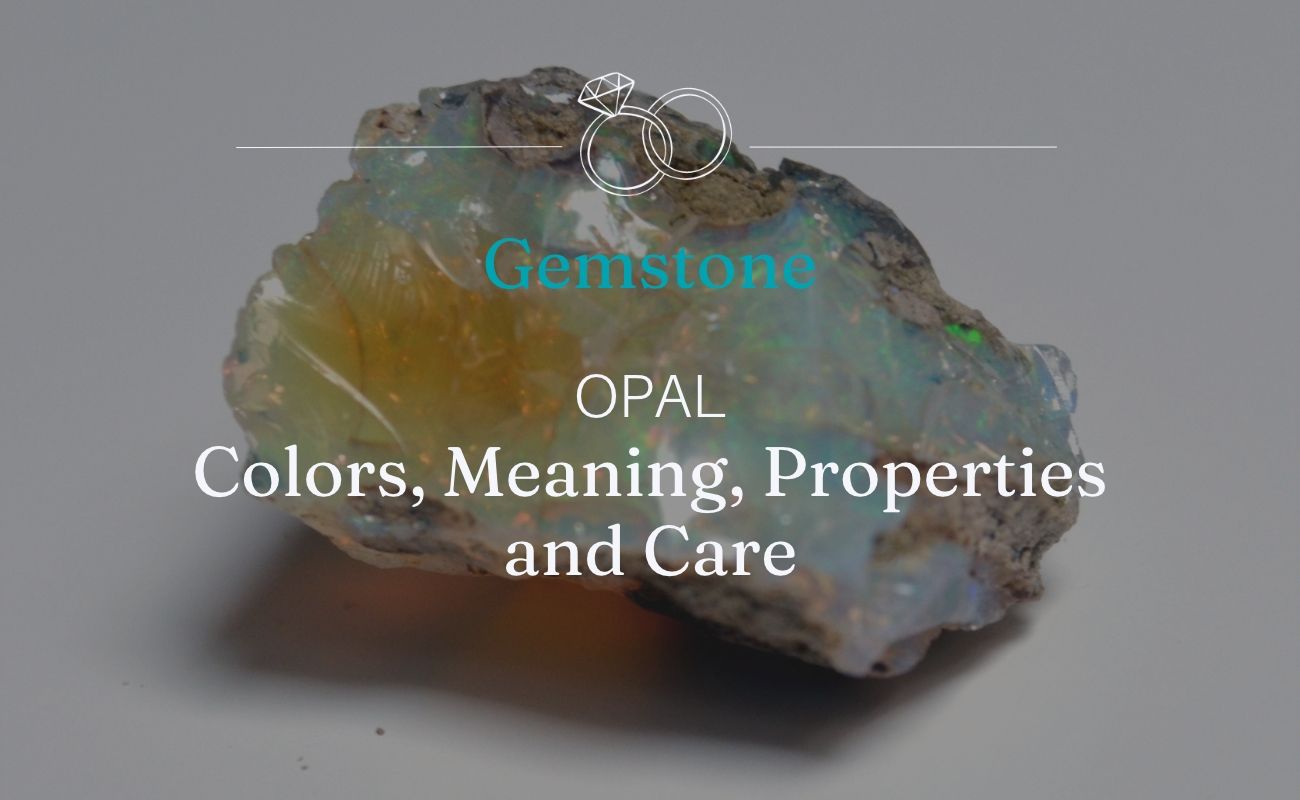
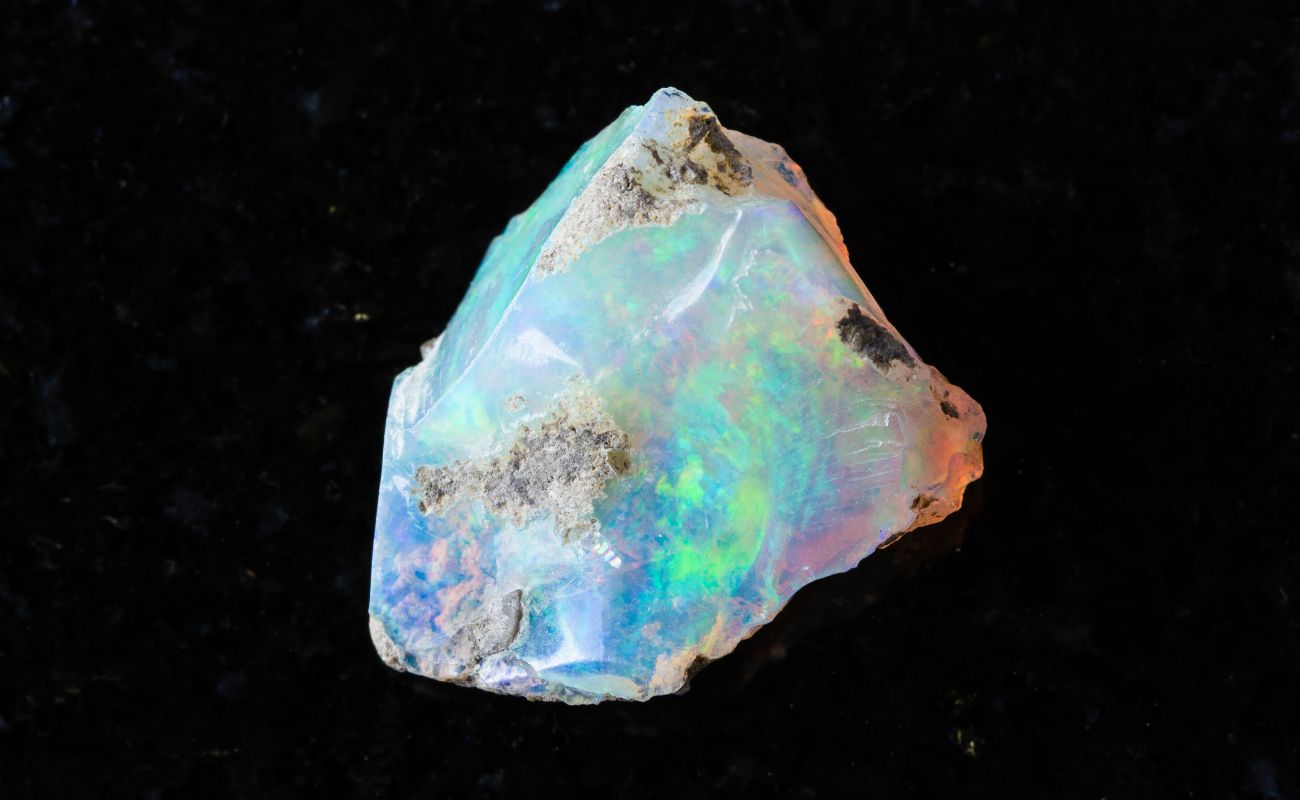
Opal has a rare gift: it seems to reveal a different face with every movement. A flash of green appears, a red glow emerges, and then blue takes its place. Some stones evoke a miniature Northern Lights display; others recall the depth of a star-filled sky. This extraordinary range of colours, never quite the same from one opal to another, makes it one of the most distinctive gemstones in fine jewellery.
But what do we really know about opal? How does it form, what do its different colours mean, which qualities have traditions attributed to it, and how can you recognise a beautiful stone? From science and history to practical jewellery advice, let us explore a gemstone that is as spectacular as it is delicate.
What is opal? A gemstone born of water and silica
Opal is a form of hydrated silica, with the chemical formula SiO₂·nH₂O. Unlike many crystalline gemstones, it does not have a regular crystal structure in the usual sense. It naturally contains water and forms when silica-rich solutions move through cracks and cavities in certain rocks. Over time, deposits of silica give rise to opal.
The stone can be white, black, translucent, orange, pink or even almost colourless. Some opals display shifting, multicoloured flashes; others have a uniform, soft, milky appearance. In gemmology, these two characteristics should not be confused.
Precious opal and common opal: what is the difference?
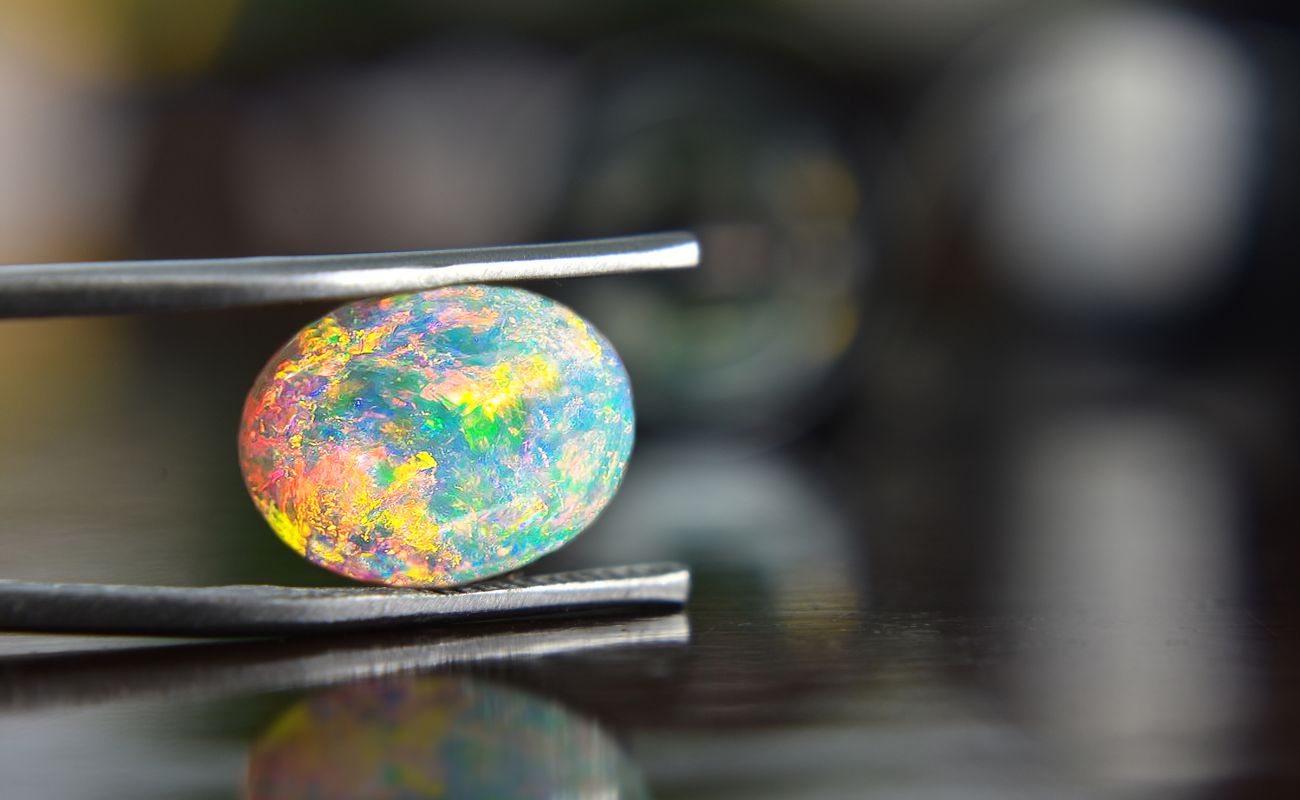
Precious opal displays a phenomenon known as play-of-colour: patches of red, green, blue or violet light seem to move as the stone is tilted. Common opal does not display this effect, although its natural body colour can be extremely attractive. Here, the words “precious” and “common” describe an optical characteristic, rather than an absolute distinction between a beautiful stone and one with no appeal.
Why does opal appear to hold a rainbow inside it?
The secret lies on a scale invisible to the naked eye. In certain opals, minute spheres of silica are arranged in a sufficiently regular pattern to diffract light. Different wavelengths are separated, producing the shifting display called play-of-colour (also known by the American spelling play-of-color). The colours we see depend on the size and arrangement of the spheres.
This phenomenon is neither paint nor a pigment applied to the surface: it is created by the gemstone’s internal structure. It also explains why every opal has its own distinctive visual character.
Opal at a glance
- Composition: hydrated silica (SiO₂·nH₂O).
- Hardness: approximately 5 to 6.5 on the Mohs scale.
- Appearance: transparent to opaque, with or without play-of-colour.
- Common cut: the cabochon, which enhances the gemstone’s flashes of colour.
- Birthstone: opal is traditionally associated with October, alongside tourmaline.
White, black, fire opal and more: the main varieties
There is not just one kind of opal, but several families with very different appearances. Body colour, transparency and the possible presence of iridescent flashes help distinguish them.
| Variety | Characteristic appearance | Distinctive feature |
|---|---|---|
| White or light opal | A white to light-grey background, sometimes crossed by multicoloured flashes. | A soft, luminous elegance, particularly appealing when cut as a cabochon. |
| Black opal | A dark background that highlights flashes of green, blue, red or orange. | Stones with vivid, extensive play-of-colour are especially sought after. |
| Boulder opal | Opal occurring together with its host rock, often a dark-brown matrix. | Irregular natural patterns that give each gemstone a unique character. |
| Fire opal | A yellow, orange or red body colour, often translucent. | It can be beautiful even without play-of-colour; its name does not imply that an iridescent effect must be present. |
| Crystal opal | Transparent to semi-transparent, sometimes with flashes visible deep within the stone. | An impression of light suspended inside the gemstone. |
| Pink or green opal | Pastel or more saturated body colours, often without iridescent flashes. | These are frequently classified as common opals and are admired for their natural colour. |
Is black opal always the most expensive? Fine black opals are often among the most highly valued because their dark body colour creates a striking contrast with the play-of-colour. Yet quality is never determined by a variety name alone: the brilliance, extent and pattern of the flashes, as well as the condition of the gemstone, are equally important.
Where do opals come from? Australia, Ethiopia and Mexico
An opal’s origin tells part of its geological story. Three sources are particularly significant in the world of gemmology.
- Australia is one of the world’s most celebrated sources of opal. Lightning Ridge is especially famous for black opals, Coober Pedy for light opals, and parts of Queensland for boulder opals.
- Ethiopia, particularly the Wollo region, produces opals that can display exceptionally bright play-of-colour. Many Ethiopian opals are hydrophane, meaning they can absorb water, which may temporarily alter their transparency or appearance.
- Mexico is particularly associated with fire opal, renowned for its warm tones ranging from orange to red.
Opals also occur in other parts of the world. Origin can be useful information when buying a gemstone, but it never replaces a careful examination of the stone itself: a fine opal should be judged first on its individual qualities and stability.
What is the meaning of opal?
Long admired for its changing appearance, opal has inspired countless stories. In European traditions, it has been associated with hope, purity and truth. Its wide spectrum of colours has also encouraged symbolic interpretations connected with imagination, sensitivity and creativity.
Opal’s reputation has not always been consistent. At times regarded as a lucky charm and at others surrounded by unfavourable superstitions, it has carried a mysterious aura through the centuries. Such beliefs belong to the cultural history of gemstones; they do not describe their physical properties.
The supposed benefits of opal in crystal healing: a symbolic perspective
In crystal-healing traditions, opal is sometimes associated with calm, inspiration and emotional expression. Different colours carry different symbolic meanings: pink opal is often linked with tenderness and affection, white opal with clarity, and fire opal with creative energy.
It is important to distinguish these spiritual and cultural associations from scientific knowledge. There is no robust clinical evidence that wearing an opal can treat illness, improve sleep or affect the body’s organs. A gemstone can hold personal symbolic value without having any proven medical effect.
Why give someone an opal?
Opal makes a particularly personal gift for someone born in October, as it is one of the month’s traditional birthstones. It may also evoke a new chapter in life, individuality or the desire to give a gemstone whose colours seem never to repeat themselves. In this sense, the most meaningful interpretation is often the one the giver and wearer choose for the jewel.
How can you recognise a beautiful opal and understand its value?
Unlike a diamond, opal cannot be judged using a perfectly comparable set of criteria from one stone to another. Its evaluation relies heavily on visual appeal. Here are the main features to consider before choosing a gemstone or a piece of jewellery.
1. The brightness and distribution of play-of-colour
With precious opal, examine the intensity of the flashes, their contrast against the body colour and how much of the surface they cover. Some stones display large areas of colour, while others reveal tiny sparks or mosaic-like patterns. Viewing the opal from different angles and under different lighting conditions can help you decide whether its appearance truly appeals to you.
2. Body colour, transparency and cut
A white, dark or transparent background strongly influences how the colours are perceived. Gemstone cutters often favour a cabochon cut, with a smooth, polished dome, to preserve and showcase an opal’s play-of-colour. A free-form outline is not necessarily a flaw: it may be the best way to reveal the beauty of a particular stone.
3. The stone's condition and any treatments
Inspect the surface for fractures or networks of fine cracks, known as crazing. You should also ask whether the opal is natural, synthetic, treated or assembled. Some opals are altered through impregnation, dyeing or surface treatments. This information should be clearly disclosed at the time of purchase.
Solid opal, doublet or triplet: understanding the differences
A solid opal is cut from a single piece of opal material. A doublet consists of a thin layer of opal attached to a backing; a triplet generally adds a transparent protective layer on top. These assembled stones can be attractive, but their construction and value differ from those of solid opal. It is therefore essential to know exactly what you are buying.
Opal prices can vary enormously according to the variety, the intensity of the colours, the stone’s stability and size, and the presence of treatments or assembled layers. It would be misleading to suggest a single price per carat for every type of opal.
Opal in fine jewellery: how to showcase its beauty
Opal lends itself to many different designs, from cabochon rings and pendants to earrings and vintage-inspired jewellery. Yellow gold can bring out its warmth, while white gold or platinum may give its reflections a cooler appearance. A halo of small diamonds can add a luminous contrast without distracting from the opal’s own colours.
Its beauty does, however, call for care. With a hardness of approximately 5 to 6.5 on the Mohs scale and variable resistance to impact, opal is more delicate than sapphire or diamond. For a frequently worn ring, it is worth considering a protective setting, particularly one that shields the edges of the gemstone. Pendants and earrings are generally less exposed to everyday knocks.
At i-diamants, we believe that beautiful jewellery is about finding harmony between the gemstone, its setting and the lifestyle of the person who wears it. This applies to opals just as much as to diamond rings: a gemstone’s character matters as much as its size.
How should you clean and care for an opal?
With proper care, an opal can retain its beauty for many years. Its sensitivity depends on the type of stone and any treatments it may have received: hydrophane and assembled opals do not necessarily require the same precautions as stable solid opals.
- Clean gently. For a stable solid opal, use a soft cloth and, if necessary, a little lukewarm, mildly soapy water, then dry carefully. If you are unsure what type of opal you own, ask a jewellery professional for advice.
- Avoid prolonged soaking. Hydrophane opals may absorb water and change in appearance; doublets and triplets may also be sensitive to moisture around the joined layers.
- Avoid aggressive cleaning equipment. Do not use ultrasonic cleaners or steam cleaning, as both can damage this gemstone.
- Protect it from heat and sudden temperature changes. High temperatures or rapid temperature fluctuations may encourage cracking.
- Store it separately. A soft pouch or individual compartment helps prevent scratches from harder gemstones, particularly diamonds.
One myth worth dispelling: not all opals need to be regularly immersed in water to “feed” them. Their needs vary according to the type of stone. The best approach is to know what you own and avoid extreme conditions.
FAQ: frequently asked questions about opal
Is opal a precious gemstone?
Opal is a gemstone used in fine jewellery. More specifically, the term “precious opal” refers to opal that displays play-of-colour, as opposed to common opal, which does not. This is a gemmological distinction, not an automatic guarantee of value or quality.
What does opal symbolise?
According to various traditions, opal represents hope, purity, creativity and sensitivity. These are cultural and personal meanings rather than medical properties.
Why does an opal change colour?
In precious opal, play-of-colour is created when light is diffracted by a particular arrangement of tiny silica spheres. The visible flashes change with the viewing angle. Some hydrophane opals may also change temporarily in appearance when they absorb water, but that is a separate phenomenon.
What is the difference between black opal and fire opal?
Black opal has a dark background that can highlight spectacular play-of-colour. Fire opal is primarily recognised by its yellow, orange or red body colour, even when it displays no play-of-colour at all.
Can you wear an opal ring every day?
Yes, but with care. An opal ring is more exposed to scratching and knocks than a pendant. It is best removed for sports, gardening or manual activities, and a protective setting is recommended.
Can opal get wet?
Brief, gentle cleaning with lukewarm, soapy water is generally suitable for stable solid opals. However, some hydrophane opals absorb water, and assembled opals require special care. Avoid prolonged soaking unless you know precisely what type of opal you have.
Opal: a beauty unlike any other
Opal’s magic lies in the meeting of a material born of water and an almost elusive optical phenomenon. Soft white, dazzling black, glowing orange or transparent, it brings an extraordinary freedom of colour to fine jewellery. Its meaning has been shaped by centuries of stories; its beauty, meanwhile, is there to be discovered in the gemstone itself.
Choosing an opal means embracing a gemstone full of character, one that deserves as much care as admiration. For a beautiful piece of jewellery, the best choice is a stone whose colours move you, a suitable setting and an approach to care that respects its delicate nature.


