Jewellery
Traveling with valuable jewelry: our tips to protect it during your trips
Traveling with precious jewelry—whether it’s your wedding band, an engagement ring, or a family necklace—adds a touch of luxury and meaning to your journeys. Whether you’re heading on a honeymoon, attending a destination wedding, or enjoying a dream vacation, these treasures can accompany you and enhance life’s most important moments. However, carrying valuable jewelry far from home requires specific precautions. In this professional and informative guide, we share detailed tips to help you travel with peace of mind while protecting both the security and brilliance of your jewelry. Follow these recommendations to fully enjoy your trip without compromising the protection of your precious treasures.
Before You Leave: Insurance and Essential Preparation
Preparation is the key to traveling confidently with valuable jewelry. Before you even close your suitcase, take a few important steps to reduce risk.
Review your jewelry insurance: Find out what coverage you have in case of loss, theft, or damage while traveling. Many home insurance policies provide limited protection for valuables outside the home. It may be wise to take out specialized jewelry insurance or add an extension to your home insurance that covers jewelry worldwide, ideally with no deductible. Comprehensive worldwide “all-risk” coverage can spare you major stress, including in cases of unexplained loss (when an item goes missing without a clear explanation). Carefully check the clauses of your current policy and consult your insurance broker if you need to adjust coverage. Traveling exposes jewelry to a range of risks depending on the destination, and some policies exclude specific countries or circumstances. Make sure your pieces are covered wherever you go, even if that means adding temporary coverage for the duration of your trip. Also consider having your jewelry re-appraised if it hasn’t been updated in several years— watch, precious metal and diamond values may have increased, and your insured amount should reflect current value.
Prepare complete documentation: If something goes wrong, having proof and documents for each piece greatly simplifies the process. Keep supporting documents for each item: photos, certificates, invoices, and appraisals. Ideally, digitize everything and store it in a secure online space so you can access it while traveling. Recommended documentation includes:
- Official appraisals – a recent valuation report confirming the piece’s worth
- Dated photographs of each item, showing details and identifying features
- Serial numbers or hallmarks, if available, to help identify the jewelry
- Copies of purchase invoices or authenticity certificates
With these documents readily accessible (for example, in a secure cloud), you can prove ownership and value in case of theft or an unexpected customs inspection. Also inspect your jewelry before departure: check for loose stones, faulty clasps, or signs of wear. If a piece shows weakness (bent prongs, fragile chain, etc.), have it repaired by a professional before traveling—or leave it safely at home. Jewelry in perfect condition is less likely to break or lose a stone during your trip.
Anticipate destination-specific regulations: Research the rules in the countries you will visit regarding jewelry and valuables. Some destinations require customs declarations for jewelry above certain amounts. To avoid unpleasant surprises, check thresholds in advance. If needed, prepare a detailed list of the items you’re carrying with approximate values, and declare them upon arrival if local law requires it. Having invoices or certificates can also help prove your jewelry is personal property and not intended for resale. When in doubt, transparency is the best approach: it’s better to spend a few extra minutes with customs than risk confiscation or fines for failure to declare.
Packing and Transport: How to Travel Safely with Your Jewelry
When it’s time to pack, one golden rule applies: your jewelry should travel with you in the cabin and be protected properly. The transport phase (plane, train, car, etc.) is critical, as losses and damage often occur during transit when people are distracted.
Invest in a proper travel jewelry case: Avoid tossing jewelry loose into a toiletry bag—your pieces deserve secure storage designed for travel. Choose a well-made travel jewelry organizer with a soft interior (velvet lining, for example) and separate compartments. This prevents pieces from knocking against each other and keeps chains from tangling. For earrings, use holders that keep pairs together without scratching. For necklaces, hooks or grooves help prevent knots. A good travel case ideally includes:
- a tarnish-resistant lining (fabric treated to help reduce metal oxidation);
- modular compartments to separate rings, pendants, necklaces, and earrings;
- attachments or supports (ring bars, stud slots, chain hooks) to keep each piece in place.
Beyond physical protection, a travel case gives you a quick visual inventory of your pieces. A simple glance before leaving a hotel room can ensure nothing has been left behind on a vanity or bedside table.
Always keep jewelry with you: This is one of the most important tips. Never place valuable jewelry in checked luggage or in a suitcase that may leave your sight during transfers. Checked bags can be lost or searched, and airlines typically disclaim responsibility for high-value items in luggage. Even if a bag is lost, airline compensation is limited and often far below the true value of fine jewelry. Keep your pieces in your carry-on, close to you in the cabin, or within reach on trains and in cars. Your carry-on is your safest option. During airport security screening, avoid placing jewelry loose in trays without supervision. Instead, keep items inside a closed pouch within your bag to reduce exposure and opportunistic theft. If you prefer discretion, you can request a private screening in some airports to avoid displaying high-value items in public.
Discretion and vigilance during transit: Stay discreet about what you’re carrying and avoid revealing the value of your jewelry. Do not pull out a branded luxury jewelry box in a public place. It’s often better to conceal jewelry in a plain container that does not attract attention. For example, place your jewelry case inside a neutral pouch or even an empty eyeglasses case so it is not obvious you are transporting diamonds. If traveling with others, you may also distribute jewelry between two people or separate carry-ons to reduce the risk of losing everything in a single incident. Never leave a carry-on containing jewelry unattended—not even for a minute—whether in an airport lounge, train station, or taxi. If you need to rest during a transfer, keep your bag in physical contact with you (for example, a crossbody bag worn under a jacket, or a backpack secured with straps wrapped around your arm). These precautions may sound strict, but airports and stations are common theft hotspots. Extra vigilance during a few hours of transit can make all the difference.
Finally, don’t overpack jewelry. The more items you carry, the harder it is to protect them and avoid misplacing something. Ideally, select only your favorite pieces or those you know you will wear, and leave the rest safe at home. Limiting quantity reduces risk and makes tracking easier. Also consider the nature of your trip: for trekking or backpack travel, expensive or sentimental jewelry may not be appropriate. For a honeymoon or a formal international event, you may decide a special piece is worth bringing—in that case, preparation and caution should be even more rigorous.
At Your Destination: Hotel Storage and On-the-Go Safety
Once you arrive (hotel, vacation rental, etc.), the next challenge is storing jewelry safely when you’re not wearing it. Here’s how to protect your pieces on-site and avoid theft or accidental loss during your stay.
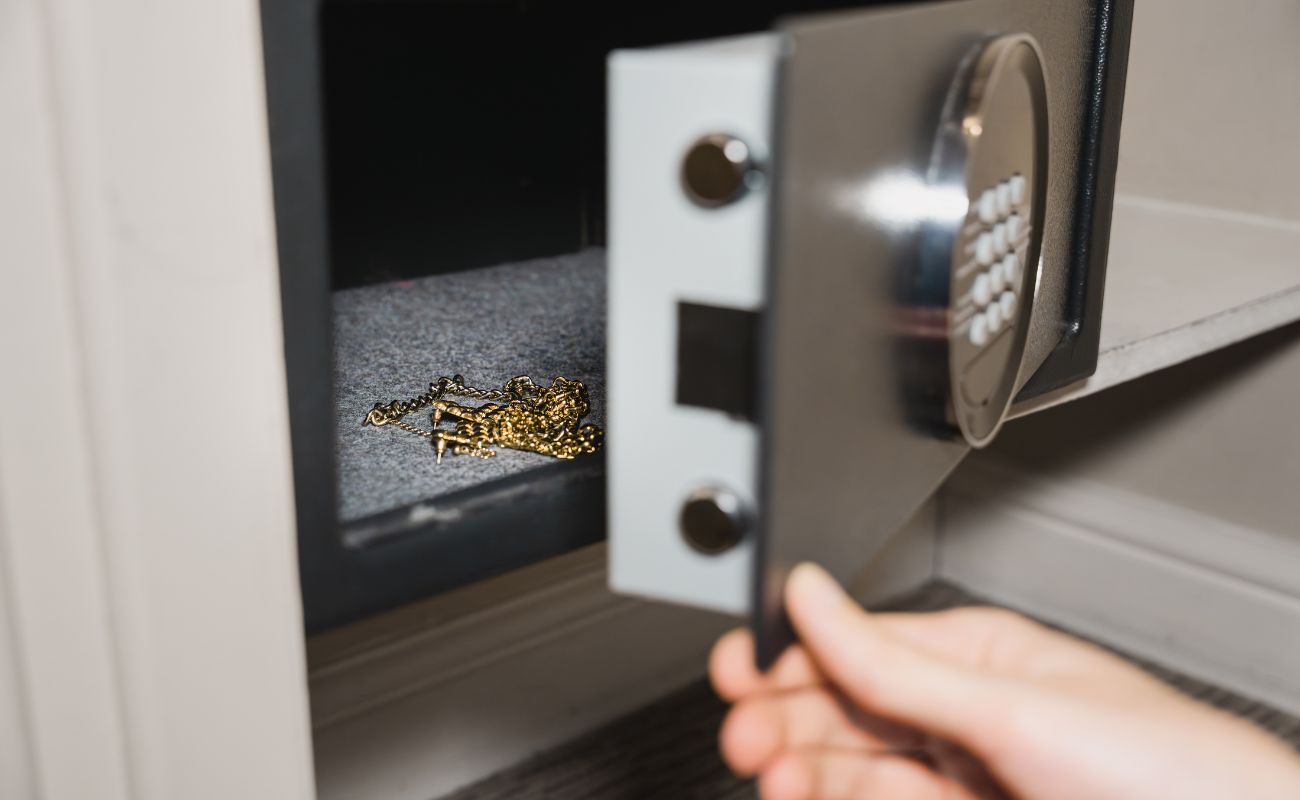
Use safes wisely: If you’re staying in a hotel, never leave jewelry out in your room when you’re away. A common solution is the in-room safe, which is better than nothing—but keep in mind these small electronic safes offer limited security. In many hotels, staff may have a master code or override key. Also, hotel liability is often limited to a low amount if theft occurs from a standard in-room safe. When possible, use the hotel’s main safe at reception: centralized vault storage typically offers stronger protection and restricted access. Ask upon arrival what secure storage options exist. In luxury hotels, don’t hesitate to ask about the procedure for depositing jewelry—some offer sealed envelopes or secure containers stored in a central safe. If you are traveling with exceptionally valuable pieces, call the hotel in advance so they can advise and prepare. If you’re staying with friends or in an Airbnb-type rental, identify a discreet, secure place (a personal safe if available, or a less obvious hiding spot than a bedside drawer). In all cases, keep jewelry out of sight and away from anyone passing through the space.
Stay alert and keep control: While moving around at your destination, never hand your jewelry to strangers, and avoid giving items to staff unless absolutely necessary. If you change hotels or rooms, carry your jewelry yourself—do not leave it inside luggage handled by someone else without your supervision. Avoid handling jewelry in public. If you must remove a ring temporarily (for example, to wash your hands), do so in a safe place and store it immediately in a secure pouch you keep on you. Never place rings on the edge of a sink in an airport or restaurant restroom—this is a classic cause of accidental loss. A helpful habit is to keep a small zip pouch in your bag: if you need to remove a piece during the day, place it inside immediately. This simple routine prevents many avoidable losses.
Also consider discretion in your appearance: if you are visiting crowded tourist areas or local markets, avoid wearing highly noticeable, recognizable pieces (large diamond rings, heavy gold necklaces). These can attract unwanted attention from pickpockets or opportunistic criminals. In higher-risk environments, choose understated jewelry—or keep valuable items in the safe and wear simpler accessories that day. You can always bring out your most spectacular pieces for a secure, elegant evening setting. In short, elegance can go hand in hand with subtlety: enjoy your jewelry, but avoid advertising its value, especially abroad.
Preserving Your Jewelry’s Brilliance: Climate, Care, and Smart Habits
Beyond theft risk, travel can also be physically tough on jewelry. Climate changes, vacation activities, tropical conditions—many factors can dull, damage, or even cause you to lose jewelry if you’re not careful. Here’s how to care for your pieces during travel so they remain as radiant as ever.
Avoid chlorinated and salt water: Sun, beaches, and pools are wonderful—but not ideal for fine jewelry. Before swimming (in the sea or a pool), remove rings, necklaces, earrings, and watches. Saltwater and chlorine can affect metals and settings, and prolonged exposure may weaken alloys or cause discoloration. Cold water can also make fingers shrink slightly, increasing the chance a ring slips off unnoticed—potentially disappearing forever. Make it a habit to remove jewelry before swimming (and ideally before showering too). Store it in a dry case rather than leaving it on a towel where it could be forgotten or covered with sand.
Watch out for sunscreen and chemicals: Products applied to skin can affect jewelry. Perfumes, lotions, and sunscreen contain chemicals and oils that can leave residue on gemstones and seep into settings, reducing sparkle and potentially loosening prongs over time. The best practice: apply beauty products and sun protection first, let them absorb, then put on your jewelry. This is especially important for porous gems and pearls. In general, avoid exposing jewelry to harsh substances: jacuzzi chemicals, abrasive sand, and heavy perspiration can all contribute to dullness or oxidation. After a hot day, gently wipe pieces with a soft, lint-free cloth to remove sweat or product residue.
Be cautious during physical activities: If your trip includes snorkeling, kayaking, beach sports, climbing, or even jogging, remove jewelry beforehand. Not only can it get lost (an earring snagging on a strap, a ring slipping during activity), but it can also be damaged. A strong impact can bend a ring or chip a stone; a delicate chain can break if pulled. Store jewelry safely while you enjoy the activity. If you must wear something, choose robust, low-risk pieces rather than valuable or sentimental items.
Clean and check your pieces regularly: During your trip, clean jewelry gently if it’s exposed to sunscreen, sand, dust, or salt. After a beach day, a rinse in lukewarm water and careful drying with a soft cloth can remove residue. For a deeper clean, use mild soap, lukewarm water, and a soft toothbrush, then rinse and dry thoroughly. After returning home, consider having your jewelry professionally cleaned and inspected. A jeweler can check that stones are secure and clasps haven’t weakened. If a small issue is detected (a bent prong or a slightly loose stone), repair it promptly to avoid losing a gemstone later.
Enjoy Your Travels with Jewelry—Safely and Stress-Free
Traveling with valuable jewelry may feel demanding, but with the right precautions, you can significantly reduce risks and enjoy your trip with peace of mind. In summary: ensure you have proper insurance, document and inspect your jewelry before departure, keep it with you during transport, remain vigilant and discreet, and adapt your habits on-site to protect pieces from both theft and physical damage. Jewelry is often connected to meaningful life moments—marriage, engagement, or family heritage—and deserves extra care when it travels with you across the world. With these professional tips, you can continue wearing your favorite pieces on your adventures while preserving both their brilliance and their safety. Safe travels—and may your precious treasures continue to shine during your most beautiful moments, wherever you are in the world.